留言
如果您对我们的产品感兴趣并想了解更多详情,请在此留言,我们会尽快回复您。

The top of a fire truck water tank is not a flat cover—it is a working platform that integrates filling, ventilation, overflow protection, firefighting equipment, and crew safety. Every component mounted on the fire truck tank top serves a specific function during water supply and firefighting operations. Understanding this fire truck layout is essential for apparatus specifiers, pump operators, and maintenance personnel.
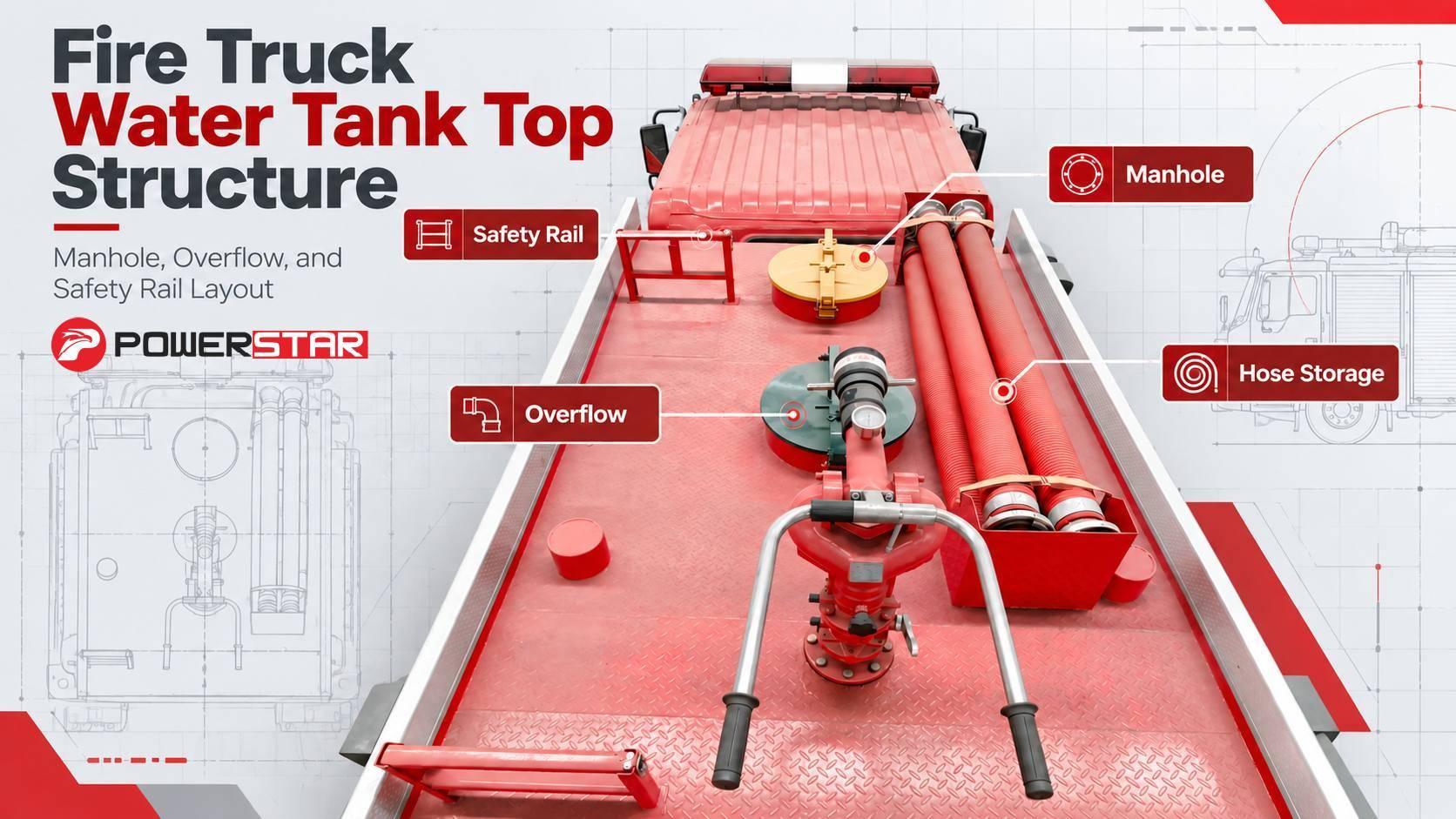
This article explains the complete top structure of a fire truck water tank, covering the manhole, overflow area, safety rail, fire monitor, hose storage, and other key components.
The top structure of a fire truck water tank typically includes: a manhole for internal inspection and cleaning, an overflow area to prevent over-pressurization during filling, a safety rail for crew protection during roof access, a fire monitor for elevated water or foam discharge, hose storage for quick deployment, and a filling connection for tank filling. Each component is positioned to support efficient water supply and safe operation.
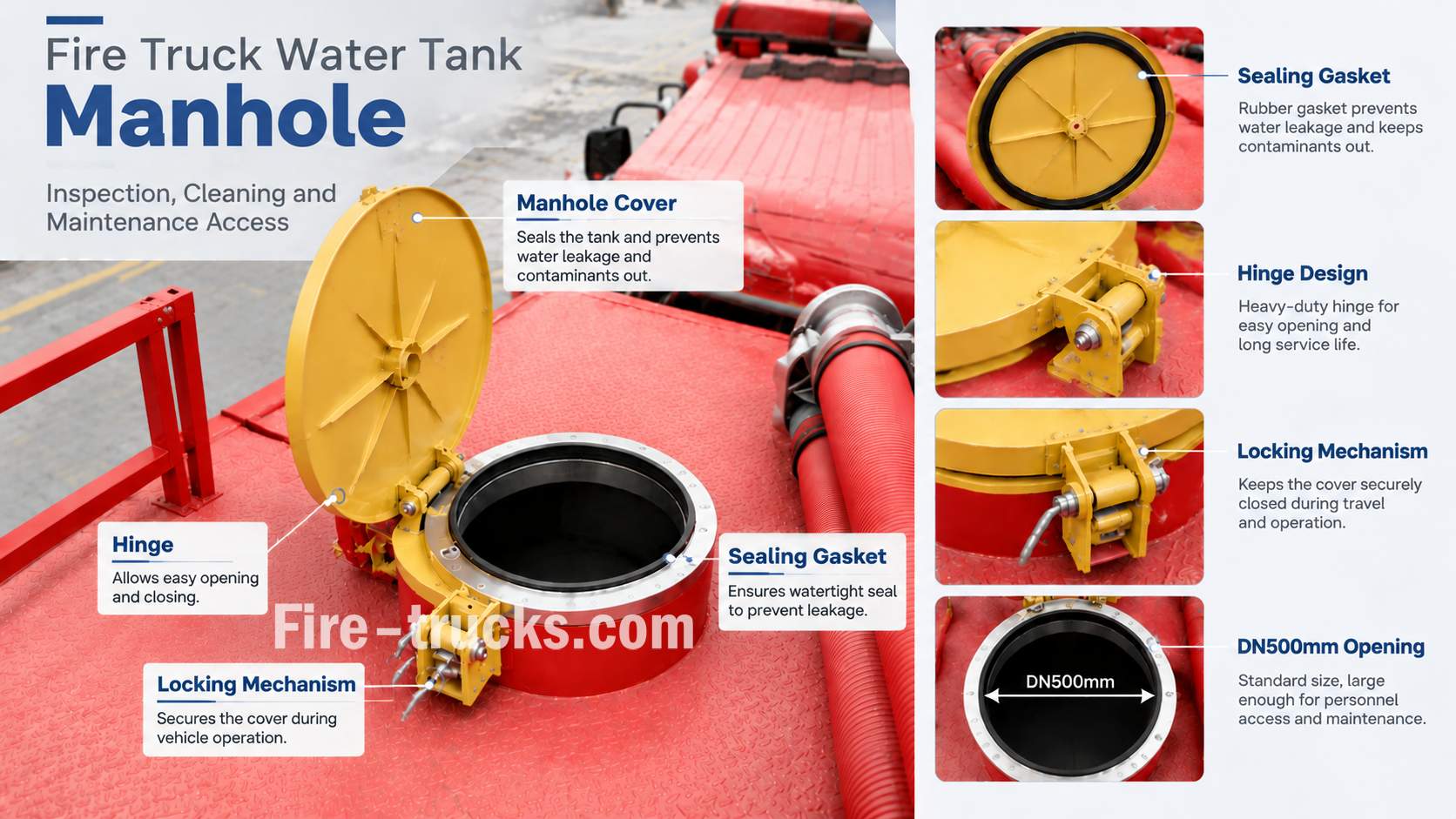
The manhole is the primary access point for internal tank inspection, cleaning, and maintenance. It is typically a circular opening with a sealed cover, located on the tank top for easy access from the vehicle roof.
Key features:
• DN500mm standard opening — large enough for personnel entry
• Sealed cover with gasket to prevent water leakage and contamination
• Hinged or removable design for convenient opening and closing
• Locking mechanism to secure the cover during vehicle operation
Function: The manhole allows operators to inspect the tank interior for corrosion, sediment buildup, and baffle condition. It also provides access for cleaning and repair. During filling, the manhole can serve as an emergency vent if the normal venting system is blocked.
Maintenance note: The manhole gasket should be inspected regularly for aging, cracking, or deformation. A damaged gasket can cause water leakage and allow contaminants to enter the tank.
The overflow area controls the discharge of excess water after the tank reaches full capacity, preventing over-pressurization and tank structural damage.
Key features:
• Overflow pipe with a diameter sufficient to handle the maximum filling rate
• Positioned at the highest point of the tank to ensure complete filling before overflow
• Screened or covered to prevent debris and insects from entering
• Drainage path directed away from the vehicle body and electrical components
Function: During hydrant filling or pump filling, the overflow area prevents water from building up excessive pressure inside the tank. If the tank is overfilled, excess water escapes through the overflow pipe rather than damaging the tank walls or venting system.
Maintenance note: The overflow pipe should be checked regularly for blockage. A blocked overflow can cause over-pressurization and tank damage during filling.
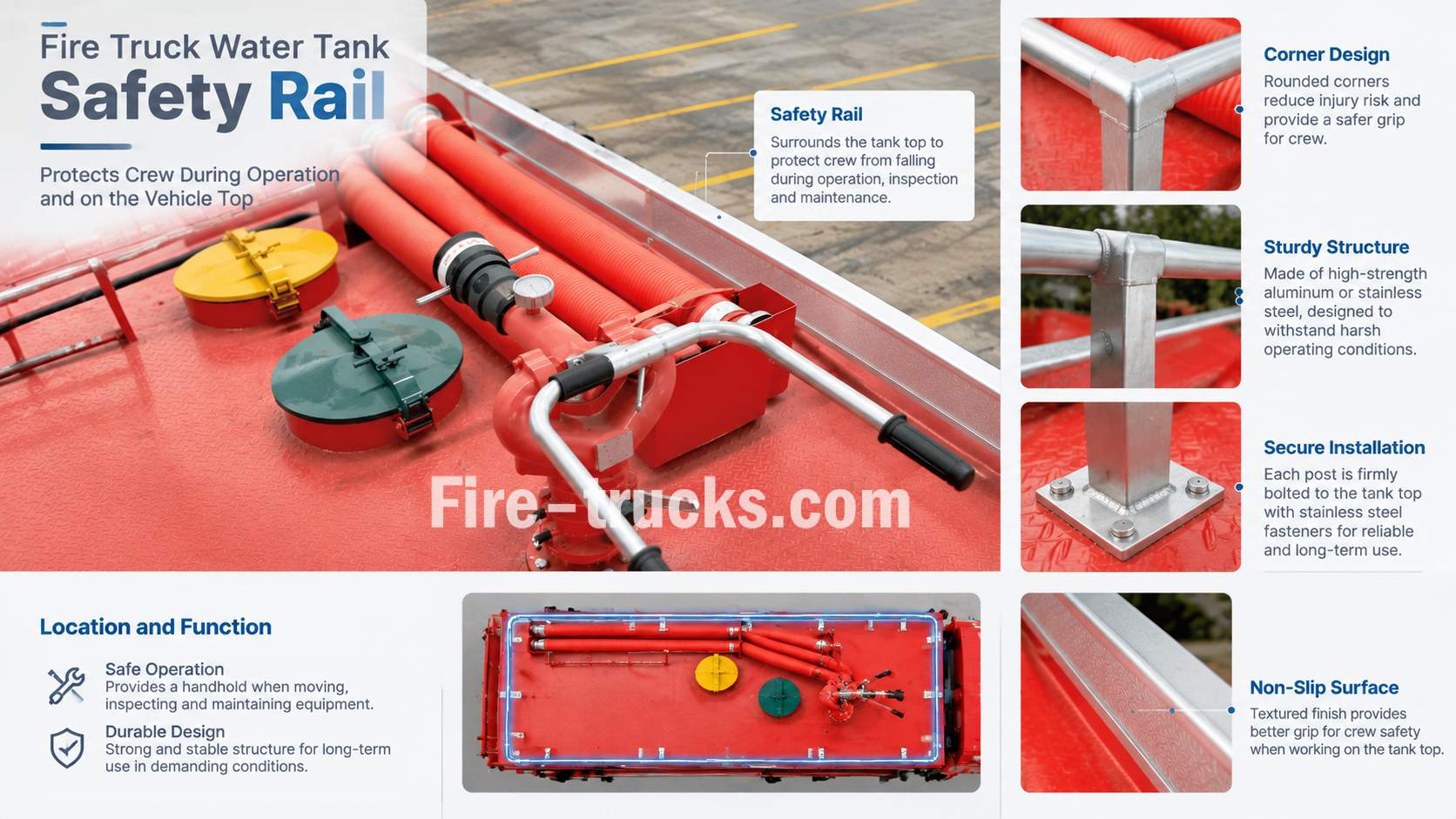
The safety rail is a handrail system mounted around the perimeter of the tank top, providing fall protection for firefighters who need to access the tank roof during operations.
Key features:
• Corrosion-resistant construction — typically aluminum or stainless steel
• Height compliant with safety standards — usually 1,000mm or higher
• Continuous or segmented design — depending on tank configuration
• Integrated with the tank structure — welded or bolted to the tank top
Function: Firefighters may need to access the tank top to operate the fire monitor, connect hoses, or inspect the tank. The safety rail provides a secure handhold and prevents falls during these operations.
Maintenance note: The safety rail should be inspected for loose bolts, corrosion, and structural damage. Any compromised section should be repaired or replaced immediately.
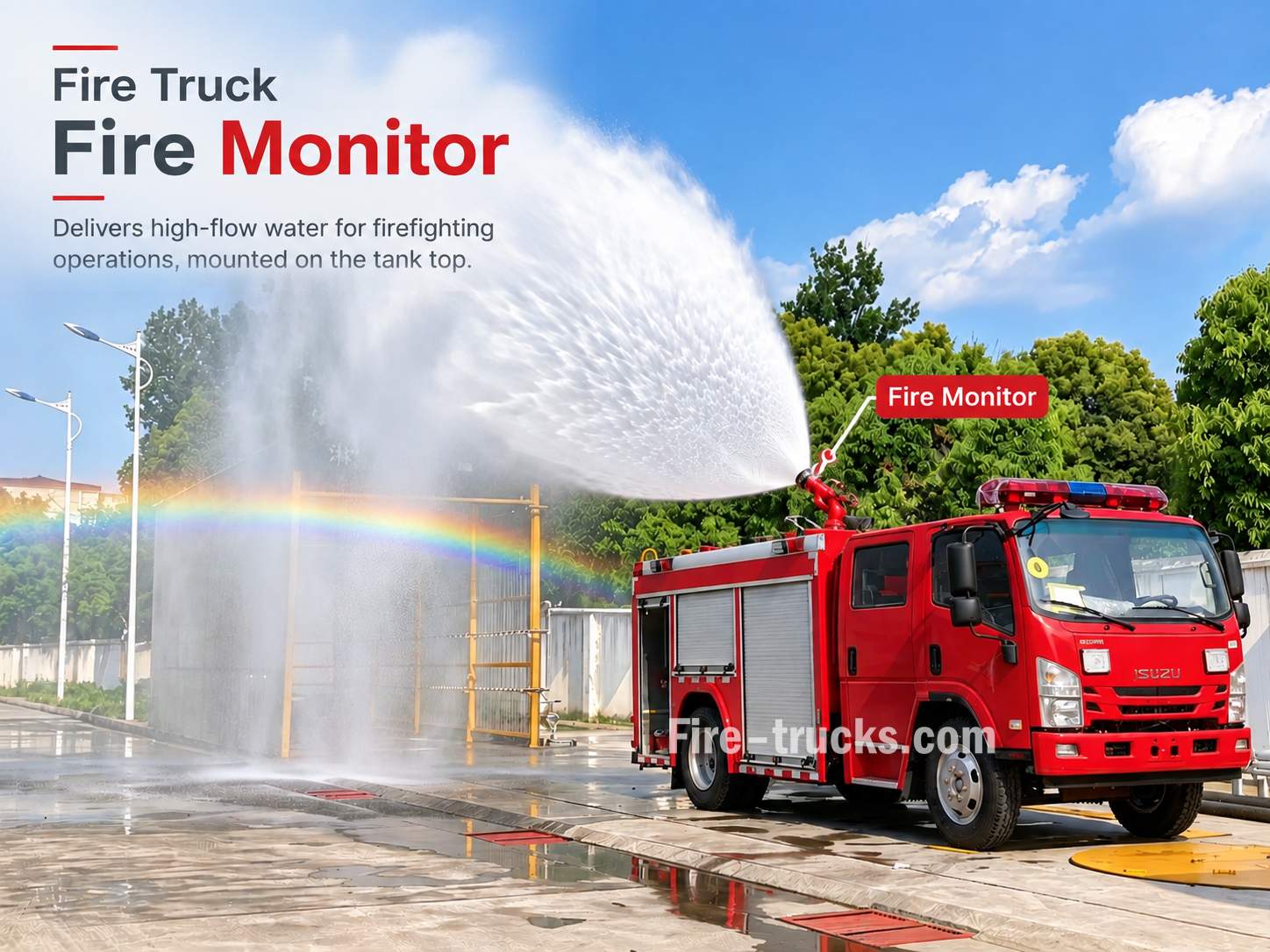
The fire monitor is mounted on the tank top, typically at the front or center, providing elevated water or foam discharge for long-range firefighting.
Key features:
• 360° rotation for full coverage
• Elevation range typically 0° to 80°, with depression capability
• Flow rate matched to the fire pump capacity
• Control options — manual, electric, or remote
Function: The fire monitor allows the operator to direct a high-volume water or foam stream at the fire from an elevated position, improving reach and coverage. It is particularly useful for tank fires, industrial fires, and situations where the fire source is inaccessible from ground level.
Maintenance note: The monitor should be inspected for smooth rotation, proper lubrication, and leakage. Any deterioration should be addressed promptly.
Hose storage is a dedicated compartment or rack on the tank top for storing fire hoses, suction hoses, or foam hoses, allowing quick deployment during emergency operations.
Key features:
• Corrosion-resistant construction — aluminum or stainless steel
• Drainage holes to prevent water accumulation
• Secure mounting to prevent hose movement during vehicle operation
• Easy access for rapid deployment
Function: The hose storage keeps hoses organized, protected, and ready for immediate use. Proper storage prevents hose damage, extends service life, and ensures that hoses are available when needed.
Maintenance note: Hoses should be inspected regularly for damage, and the storage compartment should be kept clean and dry.
Beyond the components described above, the tank top may also include:
• Filling connection — for hydrant or pump filling
• Vent — for pressure equalization during filling and discharge
• Level gauge — for monitoring water level
• Ladder or step — for safe access to the tank top
• Lighting — for night operations
Q1: What is the purpose of the manhole on a fire truck water tank?
A: The manhole provides access for internal inspection, cleaning, and maintenance. It also serves as an emergency vent if the normal venting system is blocked.
Q2: Why does a fire truck water tank need an overflow area?
A: The overflow area prevents over-pressurization during filling. If the tank is overfilled, excess water escapes through the overflow pipe rather than damaging the tank structure.
Q3: Is the safety rail required by standard?
A: Safety rails are required by many fire apparatus standards for crew protection during roof access. The specific height and construction requirements vary by jurisdiction and standard.
Q4: How often should the tank top components be inspected?
A: Tank top components should be inspected as part of the daily maintenance checklist. The manhole gasket, overflow pipe, safety rail, fire monitor, and hose storage should all be checked for damage, corrosion, or blockage.
Q5: Can the fire monitor be operated from the ground?
A: Yes. Many modern fire monitors are equipped with electric or remote control systems that allow operation from the ground or from the cab, reducing the need for roof access.
Q6: What is the best material for tank top components?
A: Aluminum and stainless steel are the most common materials for tank top components due to their corrosion resistance and durability. The specific material should be selected based on the operating environment and water quality.
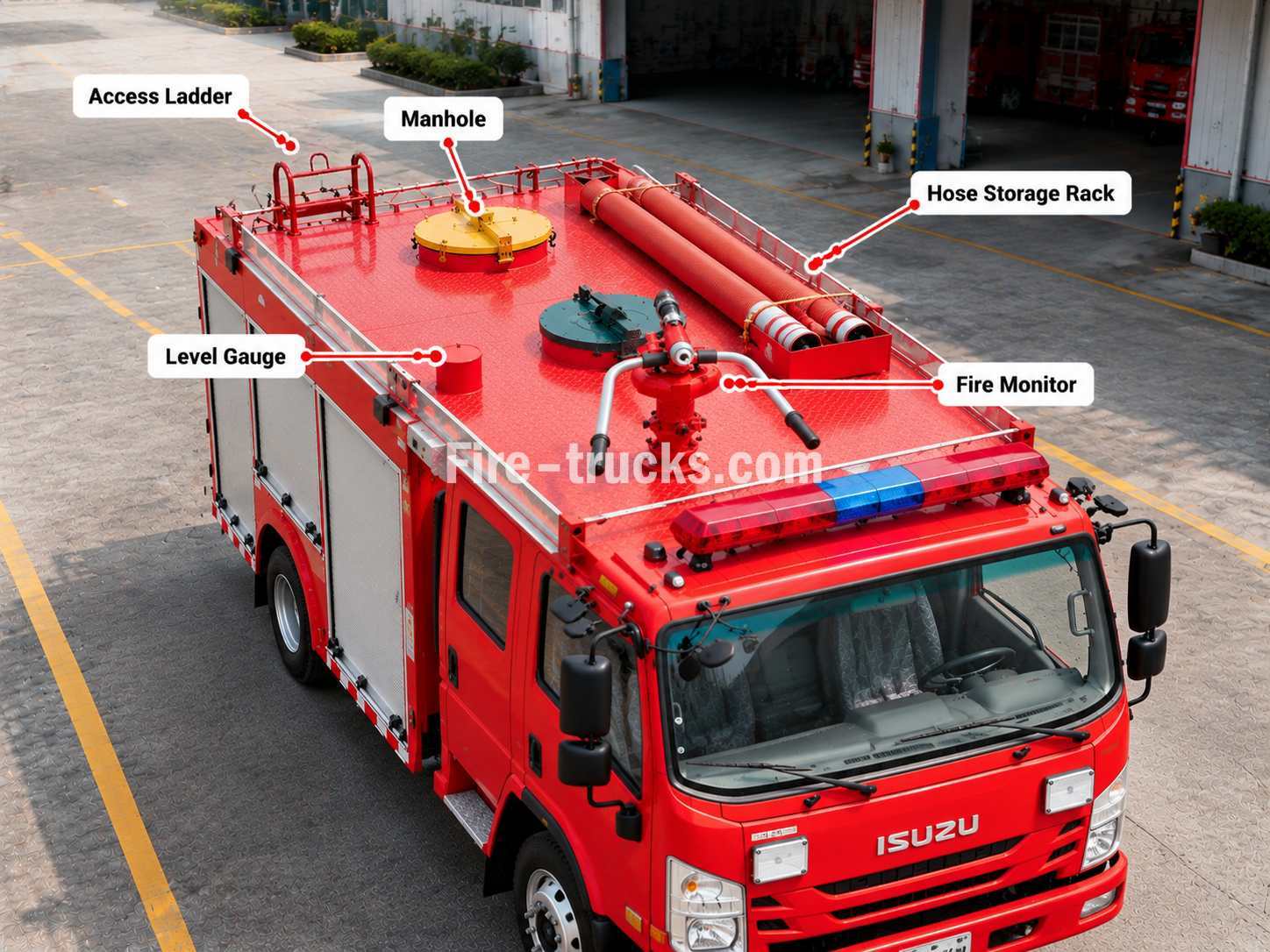
The top structure of a fire truck water tank is a working platform that integrates multiple functions:
• Manhole — inspection and cleaning access
• Overflow area — over-pressurization protection
• Safety rail — crew fall protection
• Fire monitor — elevated discharge device
• Hose storage — quick deployment and organization
• Additional components — filling, venting, level monitoring, access, and lighting
Each component is positioned to support efficient water supply and safe operation. Regular inspection and maintenance of these components ensure reliable performance when the fire truck is needed most.


您可能对以下信息感兴趣
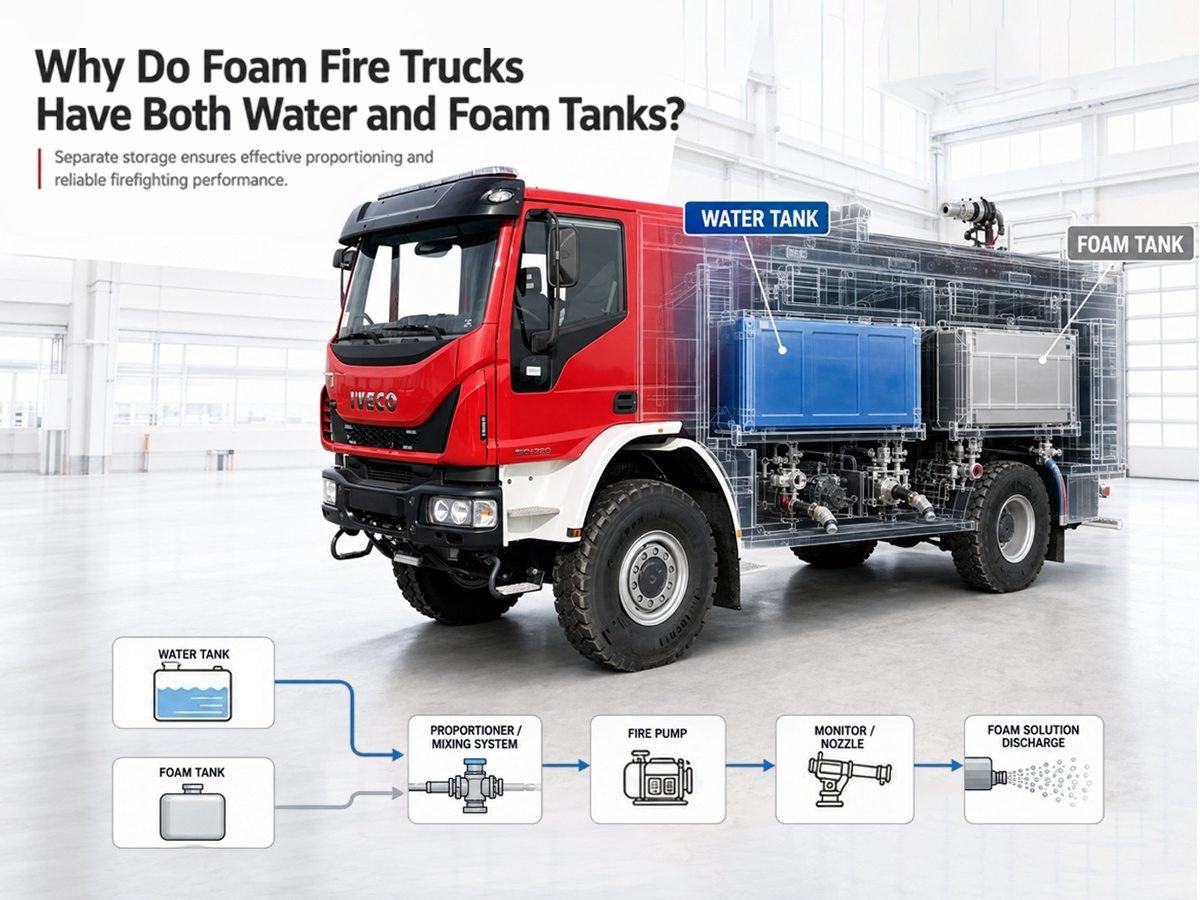
泡沫消防车将专用泡沫浓缩液罐、独立的水箱和精确的比例混合系统结合在一起。它们利用比例混合系统将泡沫浓缩液以特定浓度(通常为1%、3%或6%,具体取决于泡沫浓缩液的种类和消防应用)注入水流中。双油箱这种设计允许消防员在不需要泡沫时仅使用水,仅在需要时才使用泡沫浓缩液。这提高了操作灵活性,有助于控制泡沫消耗,并使消防系统能够针对不同的火灾危险进行配置。 泡沫消防车的核心工作原理和关键技术,特别是为什么它们既有水箱又有泡沫箱,是许多客户关注的焦点。今天我们就来了解一下。 简答: 泡沫消防车通常使用独立的水箱和泡沫浓缩液箱,因为水和泡沫浓缩液的用量比例不同,而且需要在灭火过程中混合使用,而不是像预混液那样长期储存。水箱提供主要水源,而泡沫箱则储存浓缩泡沫剂。比例控制系统控制注入水流中的泡沫浓缩液量,使消防车能够在纯水灭火模式和泡沫灭火模式之间切换。 我。 泡沫消防车的主要组成部分有哪些? 1. 水箱 采用耐腐蚀材料(碳钢防腐涂层或不锈钢),容量范围从4000升到6000升。配备挡板以减少车辆行驶过程中液体的晃动,并采用柔性支架来吸收在崎岖地形上行驶时底盘的弯曲。 2. 泡沫浓缩液罐 采用不锈钢结构,可抵抗活性泡沫浓缩液的化学侵蚀,容量通常为 500-2,000 升。 根据泡沫浓缩液和系统设计,储罐可能包含循环或搅拌装置等功能,以帮助在储存期间保持浓缩液的状态。 3. 泡沫比例混合系统 一种比例分配系统,用于从专用装置中抽取泡沫浓缩液。泡沫将泡沫浓缩液注入储罐,并以特定浓度注入水流中。根据泡沫浓缩液和系统设计,比例控制可采用平衡压力、泵驱动或文丘里管技术。 4. 消防泵 消防泵是整个泡沫灭火系统的动力源。它从水箱中抽取水,并将其加压至消防作业所需的流量和压力。消防泵通常由车辆的动力输出装置(PTO)或独立发动机驱动,并且必须与比例混合系统兼容,以确保在不同的流量下都能精确喷射泡沫浓缩液。常见的配置包括用于标准作业的单级离心泵和用于高压应用的多级泵。 5. 泡沫监视器 泡沫炮以可控的流量和喷射范围将成品泡沫溶液喷射到火源处。根据车辆配置,该炮可手动或远程操作,并可配备可调节的流量和喷射模式,以适应不同的消防应用。 二、为什么泡沫消防车要使用单独的水箱和泡沫箱? 要了解泡沫消防车的核心设计,我们首先必须回答一个问题: 为什么水和泡沫浓缩液通常不以预混溶液的形式储存? 在传统的泡沫灭火系统中,水和泡沫浓缩液通常是分开储存的,而不是预先混合好的溶液。 1. 长期储存会影响泡沫溶液的稳定性 泡沫浓缩液用水稀释后,所得泡沫溶液通常仅供立即或短期使用,不宜长期储存。其稳定性取决于泡沫配方、水质、温度、污染情况和储存条件。 2. 预混泡沫溶液可能受储存条件的影响 泡沫溶液是一种配制混合物,其稳定性取决于多种因素: • 泡沫配方 不同的泡沫浓缩液具有不同的化学配方,因此稀释后的稳定性也会有所不同。 • 水质和储存条件 水质、温度、污染和储存条件都会影响泡沫溶液的稳定性。 • 专注力和消防表现 长期储存可能会使维持预期浓度和灭火性能变得更加困难。 3. 无法切换消防模式 如果只有一个大水箱,并且已经预先混合了泡沫溶液,那么车辆就失去了使用普通水的能力。 消防员到达现场后,必须评估情况并做出决定: • 普通建筑火灾(A类)只需清水即可扑灭,无需泡沫灭火剂。 • 燃料火灾(B类)需要使用3%的泡沫灭火剂 • 极性溶剂火灾需要6%的泡沫比例 三、水箱和泡沫箱如何协同工作? 第一步:水箱为消防泵供水 水箱中的水通过吸水软管进入消防泵。 步骤二:消防泵增加压力 消防泵对水进行加压,并提供消防系统所需的流量。 步骤 3:泡沫罐供应泡沫浓缩液 当操作员启动泡沫系统时,泡沫浓缩液会从泡沫罐流入泡沫管道。 步骤 4:比例器控制泡沫流量 比例器按预设比例将一定量的泡沫浓缩液添加到水流中。 步骤 5:形成泡沫溶液 水和泡沫浓缩液完全混合形成泡沫溶液。 步骤 6:通过监视器或泡沫喷嘴排放 泡沫溶液通过炮筒、泡沫喷嘴或其他泡沫发生装置向火源喷射。 IV. 为什么泡沫罐通常比水罐小得多? 泡沫罐通常比水箱小得多——这不是为了节省成本,而是泡沫配比原理的直接结果。 1. 泡沫浓缩液与水的混合比例并非1:1。 将泡沫浓缩液按特定百分比(通常为 3% 或 6%)注入水流中。 按标称比例 3% 计算,1000 升成品泡沫溶液大约含有 30 升泡沫浓缩液和 970 升水。 2. 产能比由消耗率决定 例如,在1000升/分钟的排放速率和3%的比例下,该系统大约消耗30升/分钟的泡沫浓缩液。假设500升的泡沫液罐能够完全利用,那么在此速率下,该罐大约可以提供16.7分钟的连续泡沫溶液排放。 因此,泡沫液储罐通常比水箱小得多,因为泡沫液的消耗量远低于水箱。然而,实际的水泡沫比取决于车辆的任务、泡沫类型、所需的喷射持续时间和系统设计。 3. 泡沫罐的容量取决于车辆的作战任务。 • 城市主力消防车:主要用于扑灭建筑物火灾——泡沫仅用于扑灭小型燃料火灾 → 较小的泡沫罐(例如,500 升) • 工业消防车:主要用于储罐区或化工厂火灾——大容量、长距离泡沫喷射 → 更大的泡沫罐(例如,2,000 升) 五、典型配置和选型指南 按任务类型划分的典型水箱与泡沫液比例: 车辆类型 水箱 泡沫罐 典型用途 城市消防车 4,000 升 500升 建筑物火灾和有限的易燃液体事故 工业泡沫消防车 6,000 升 2,000 升 石油化工和工业消防 重型工业消防车 5,000–10,000 升 1,000–2,000 升 大型工业和危险区域应用 六、关于泡沫消防车水箱的常见误解 Misconception 1: Water and foam concentrate are stored together Generally not. They are stored separately in water and foam tanks, and mixed through the proportioning system during use. Misconception 2: A larger foam tank means stronger firefighting capability Not necessarily. Foam tank capacity mainly determines foam concentrate reserve. The fire pump, proportioner, and monitor together determine the actual output capability of the entire foam system. Misconception 3: All foam fire trucks have the same water-to-foam tank ratio No. Different firefighting missions require different system ...
细节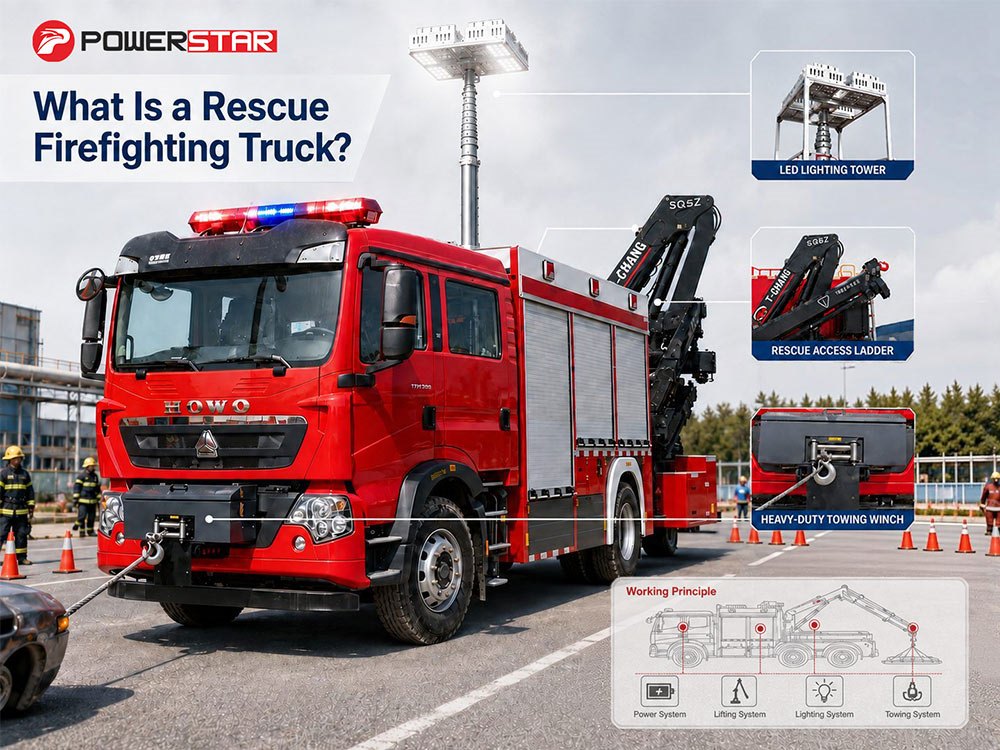
救援消防车是一种专门设计的应急车辆,既能灭火又能救援。与主要侧重于灭火的普通消防车不同,救援消防车将消防设备与救援工具、起重和吊装设备、切割和扩张工具、绞车、发电机和照明系统结合起来。 本文解释了什么是救援消防车,它与其他消防车辆有何不同,它携带哪些设备,以及何时部署。 一、什么是救援消防车? 救援消防车是一种多功能应急车辆,它集消防能力和专业救援设备于一体。其主要用于在发生涉及人员、车辆、建筑物或工业设施的事故时提供全面的应急响应能力。 根据车辆配置的不同,救援消防车可以配备各种各样的救援工具和消防系统。实际的设备选择取决于车辆的预期用途。例如,用于城市救援的车辆的设备布局可能与用于工业救援、地震响应或公路交通事故救援的车辆有所不同。 二、救援消防车配备哪些设备? 救援消防车上配备的设备取决于车辆的设计和预期用途。但是,大多数型号的设备可以分为几个主要类别:消防设备、救援工具、动力设备、照明设备、起重和牵引设备以及个人防护装备。 1. 消防设备 消防设备可能包括灭火器、消防水带、消防喷嘴、便携式水泵、水箱、泡沫灭火系统、消防炮及其他灭火工具。 2.液压救援工具 液压救援工具常用于交通事故救援行动中,用于切割、撑开或提升受损车辆结构。常用设备包括液压切割机、液压撑开机和液压缸。 3. 发电机 当现场没有外部电源时,发电机可以为救援工具、照明设备、通讯设备和其他设备提供电力。 4. 照明设备 应急照明系统帮助救援人员在夜间、建筑物内、高速公路上以及其他光线昏暗的环境下开展作业。 5.绞车和牵引设备 有些救援消防车可以配备绞盘和牵引设备,用于在救援行动中移动受损车辆或搬运重物。 三、救援消防车与普通消防车 标准消防车通常主要用于灭火。它可能配备消防泵、水箱、泡沫液罐、消防水带、消防喷嘴和消防炮,用于扑灭和控制火灾。相比之下,救援消防车更注重救援设备的配置,同时保持灭火能力。 特征 救援消防车 标准消防车 主要目的 救援 + 消防 灭火 液压救援工具 常用设备 通常不是主要设备 消防泵 根据配置而定 常用设备 水箱 可选/取决于配置 常用设备 发电机 常见的 选修的 照明系统 常见的 根据配置而定 绞盘 通常可用 不太常见 救援能力 高的 中等/有限 消防能力 根据配置而定 主要功能 关键在于,救援消防车并非只是配备更多设备的普通消防车。其设备布局通常是围绕多用途应急响应而设计的。 四、救援消防车在哪些地方使用? 救援消防车可用于各种紧急情况,尤其是在仅靠消防设备无法满足现场救援需求的情况下。 1. 交通事故救援 用于道路交通事故、车辆碰撞以及人员被困在受损车辆内的情况。 2. 建筑物倒塌 在建筑物倒塌事故中,救援设备可以帮助救援人员清理废墟并接近被困人员。 3. 工业紧急情况 工业设施可能同时存在多种风险,包括火灾、机械危险、化学品危险和重型设备危险。救援消防车可以配备针对这些环境的专用设备。 4. 自然灾害 根据车辆配置的不同,救援消防车可用于地震救援、洪水救援、风暴救援以及其他灾后救援行动。 5. 机场紧急情况 用于飞机事故、燃油泄漏和坠机后灭火。 五、救援消防车有哪些优势? 1. 多用途能力 最大的优势之一是,一辆汽车可以支持多种类型的紧急救援行动。 2. 更快的应急响应 当救援和消防设备集成在同一辆车上时,在某些事故情况下,救援队无需等待第二辆专用车辆到达,从而有助于提高现场响应效率。 3. 更佳的设备集成 Equipment can be centrally organized in dedicated compartments, allowing firefighters to quickly locate and access the tools needed at the scene. 4. Suitable for Complex Emergencies The combination of firefighting equipment and rescue tools makes this vehicle particularly suitable for complex incidents involving multiple hazard factors. VI. Rescue Fire Fighting Truck Specifications There is no single standard configuration that applies to all rescue fire fighting trucks. Specific parameters will vary based on chassis, body design, equipment configuration, and the intended application. Common specifications that buyers may need to compare include: Specification What to Check Chassis 4×2, 4×4, 6×4, etc. Engine Power and emissions GVW Maximum permitted vehicle weight Equipment body Capacity and layout Generator Rated power Winch Pulling capacity Hydraulic tools Cutter, spreader, ram Lighting Mast height and lighting capacity Fire pump Flow and pressure Water tank Capacity Foam system Foam tank and proportioning system Fire monitor Flow and range VII. Frequently Asked Questions (FAQ) Q1: What is a rescue fire fighting truck? A rescue fire fighting truck is a specialized emergency vehicle that combines firefighting equipment with rescue tools for handling complex emergency situations. Q2: What equipment does a rescue fire fighting truck carry? It may carry hydraulic cutters, spreaders, rams, winches, generators, lighting equipment, fire hoses, nozzles, fire extinguishers, fi...
细节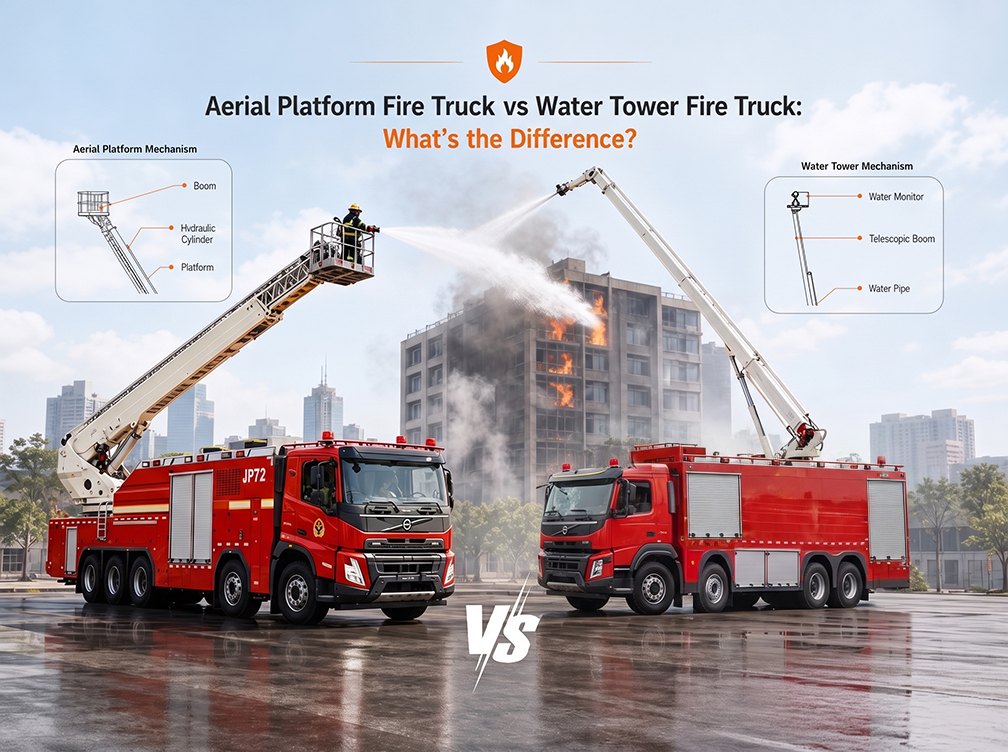
在高层建筑、工业设施或大型仓库的灭火作业中,云梯消防车不可或缺。但在各种类型的举高消防车中,有两种经常令人混淆:举高平台消防车和水塔消防车。虽然它们乍看起来相似——都配备液压臂架,并用于高空灭火作业——但它们承担的任务有着本质区别。 本文将解析这两类车辆之间的主要差异,帮助消防行业专业人员、采购经理和设备经销商根据实际作业需求做出明智决策。 一、什么是举高平台消防车? 根据中国国家标准 GB 7956.12-2015,这两种车辆都属于举高消防车类别——即配备升降臂架、转台和消防设备,用于高空作业的车辆。然而,它们的具体定义突出了一个关键区别。 举高平台消防车 举高平台消防车配备折叠式或折叠伸缩组合式臂架、人员平台、转台以及消防装置。其定义性特征是臂架末端的工作平台(斗),消防员可以站在平台上进行救援和灭火作业。 主要特点:• 配备可承载750 磅至超过 1,500 磅人员和设备的平台• 兼具救援和灭火功能——消防员可直接在平台上操作• 平台可配合下降控制装置、液压绞车或救援滑槽使用• 与水塔消防车相比,具有更大的水平伸展范围和更大的作业跨度 二二、什么是水塔消防车? 水塔消防车配备折叠式或折叠伸缩组合式臂架、转台以及消防装置——不配备人员平台。相反,臂架顶端安装有消防炮(水炮),可从地面进行远程控制。 主要特点:•无人员平台——消防员通过远程控制在地面进行操作• 专注于高空灭火,而非救援• 提供极高的水流量—超过每分钟 2,000 加仑适用于许多工业型号• 专为无需救援能力的工业消防保护而设计 III. 并排比较 功能 云梯平台消防车 水塔消防车 主要功能 救援 + 灭火 仅灭火 臂端设备 供人员使用的工作平台(斗) 消防炮(水炮) 臂架上的人员 是—消防员可从平台进行操作 否—通过遥控从地面操作 救援能力 高—可疏散受困人员 无 水流量能力 最高可达 1,500+ GPM 2,000+ GPM(工业型号) 典型作业高度 50–130 英尺 50–130 英尺 平台/斗容量 750–1,500+ 磅 不适用 重量 更重(例如 54 米型号重 36 吨) 相对较轻 最适用于 城市高层建筑救援、多功能消防部门 工业场所、大规模灭火 Ⅳ. 何时选择云梯平台消防车 云梯平台消防车是终极多用途高空消防设备—它在一辆车上同时实现灭火和救援功能。工作平台在高处提供稳定、安全的作业环境,大幅降低使用地面梯攀爬所带来的危险。 最适合用于:•城市高层建筑救援行动—从高层疏散被困居民•需要一辆车辆实现多种功能的消防部门—该平台可用于通风、救援和灭火•需要人员直接在高空火灾现场作业的场景—例如破窗、开展搜索行动或精准控制消防水流 优势:• 更高的人员和设备承载能力• 适用于混合响应部门的更广泛功能多样性• 平台可安装额外工具(水枪、热成像摄像机、救援设备) 缺点:• 比同类水塔消防车更重且成本更高• 由于结构更复杂,维护要求更高• 在纯灭火任务中,设置时间比水塔消防车更长 V. 何时选择水塔消防车 水塔消防车专用于持续、大流量的高空灭火,适用于不需要救援能力的情况。由于没有人员平台,其设计更简单、成本更低,而且关键是无需承受救援平台的重量和复杂性即可实现更高的供水流量。 最适合用于:•工业消防保护—石油储罐区、化工厂、大型仓库•拥有独立救援车辆的消防部门—将水塔消防车专用于消防供水•具有大型建筑占地面积的地点,需要从高处位置提供极高流量的水流•注重预算的消防部门,其救援能力已由其他消防装备覆盖 优势:• 许多型号具有更高的供水流量能力(2,000+ GPM)• 相比带平台的同类车辆,成本更低且维护更简单• 对于纯压制操作,略轻且更易于定位 缺点:• 无救援能力—无法疏散被困人员• 消防员必须通过遥控从地面操作,降低了现场操作灵活性• 必须依靠其他车辆进行救援作业 Ⅵ. 关键设计和性能差异 作业高度和伸展范围 两种车辆类型的作业高度范围均约为50英尺至超过130英尺。然而,云梯平台通常提供更大的工作跨度—即跨越障碍物进行水平延伸的能力—这是由于其可折叠伸缩臂的灵活性所致。 水塔车虽然通常结构更简单,但可能配备大跨度多节臂(例如某些型号采用的6节折叠臂),可向前伸展至58米、向上伸展至62米,并具备向下延伸45米的能力。 重量和空间要求 云梯平台消防车由于加强型臂架和平台结构而明显更重。例如,一辆54米高的云梯平台消防车重量可达36吨,而同等高度的水塔车可能更轻。这种重量差异会影响: • 桥梁和道路承载限制—较重的车辆可能会被限制通行某些路线• 支腿展开范围—大型设备需要更多空间进行稳定支撑(通常为18英尺或以上)• 燃油消耗和运营成本 部署和响应时间 对于纯消防压制作业,水塔车通常部署更快。一台80米级云梯平台可能需要200秒以上的理论设置时间,而实际准备工作(现场勘察、支腿稳定、水源连接)在现实条件下通常需要5到10分钟。。水塔的吊臂结构更简单且没有平台,因此通常可以更快部署。 流量能力 这正是水塔真正发挥优势的地方。工业级水塔可以提供超过每分钟2,000加仑的水流量——远高于空中平台消防车通常可提供的1,500 GPM流量。这使水塔成为大型工业设施中以大流量灭火为最高优先事项时的首选。 流量对比 空中平台 水塔 典型最大流量 1,500+ GPM 2,000+ GPM 主要优先目标 人员救援 + 中等流量 用于压制火势的最大流量 VII. 安全考虑 两种车辆类型都配备了重要的安全功能。然而,平台式云梯车在人员安全方面具有一项重要优势:在平台上作业的消防员始终受到防坠落系统的保护,从而降低了高空坠落风险。 相比之下,水塔让所有人员都保持在地面上——完全消除了坠落风险。这在危险情况下具有显著优势,例如1998年亚利桑那州坦佩市的纵火火灾中,一名站在直梯顶端的消防员险些被火球夺去生命;后续安全评估促使许多部门为了人员安全而转向专门使用空中平台。 VIII. 实际使用案例 空中平台:高层城市救援 在2026年徐州“苏超”足球赛事期间,一辆DG101空中平台消防车(101米作业高度、27米作业幅度、400千克平台承载能力)被部署在徐州奥林匹克体育中心,用于救援和监控任务。该车辆具备360度旋转能力、4,800 L/min灭火系统以及快速部署能力(96秒完成设置),非常适合人群保护和赛事保障。 水塔:大跨度工业火灾 在2015年北京大红门木材市场火灾中,一台国际品牌的44米水塔被投入使用。当其伸缩吊臂因障碍物无法到达目标位置时,一台配备6节折叠吊臂的48米水塔被调派前往。它越过障碍物,将出水口直接送至火源处,并成功控制火势超过4小时。该案例突出了现代水塔的水平伸展优势,尤其是配备可折叠吊臂的水塔。 Ⅸ. 采购考虑因素 在决定选择这两种车辆类型时,应考虑以下因素: 因素 空中平台 水塔 部门救援能力 可作为主要救援车辆使用 需要配备独立的救援设备 建筑高度 两者覆盖相似的高度范围(50–130+ 英尺) 两者覆盖相似的高度范围 工业型 vs. 城市型 城市混合用途部门 工业/仓储为主的部门 水流需求 中等流量(1,500+ GPM) 高流量(2,000+ GPM) 预算 更高成本 更低成本 ...
细节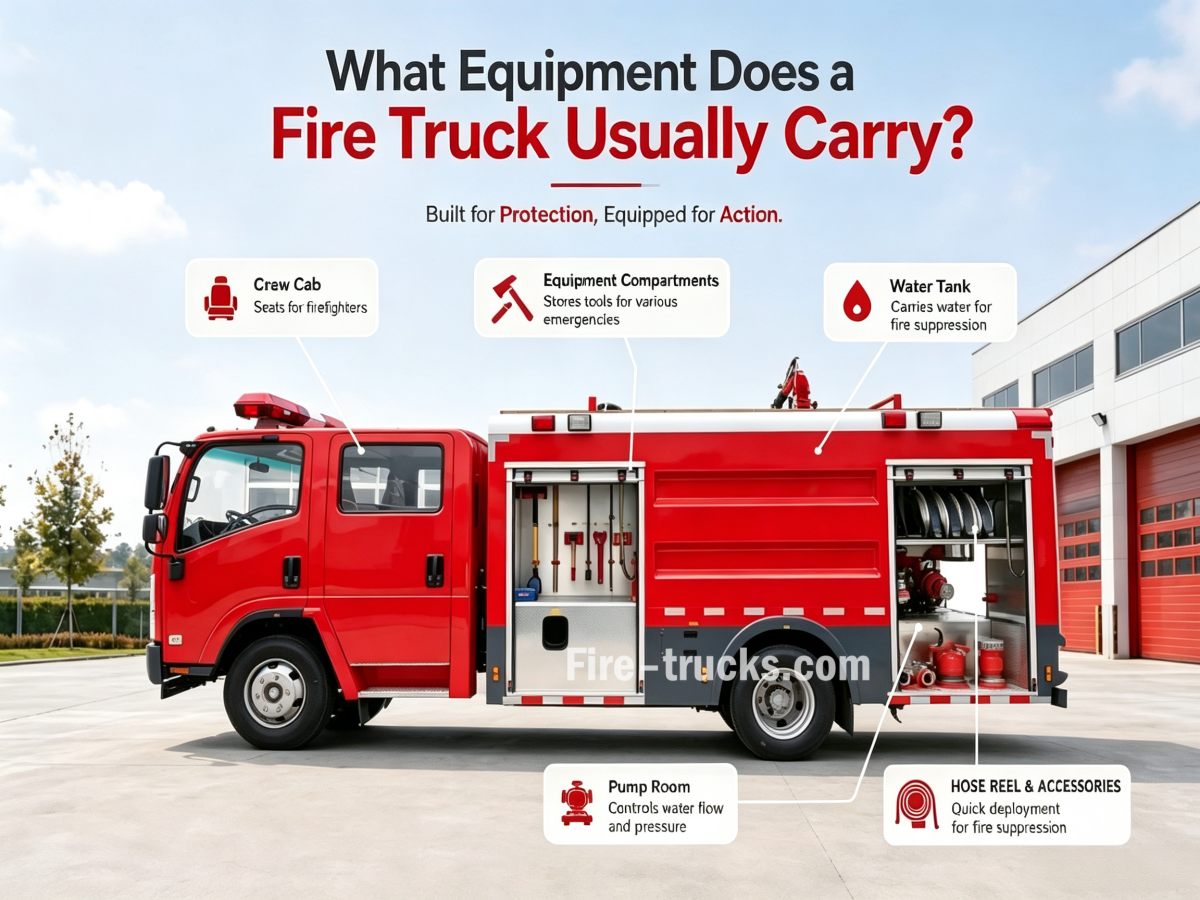
消防车通常携带灭火、供水、救援和安全防护设备。常见设备包括消防泵、水罐、消防水带、消防水枪、消防炮、阀门、消防梯、救援工具、防护装备和通信设备。本文系统解析标准消防车设备的分类、功能和选型注意事项,帮助采购专业人员和最终用户全面了解消防车辆配置。 一、消防车设备分类 1. 灭火设备— 用于直接灭火的核心工具,包括消防水枪、消防炮、消防水带、分水器和接口。 2. 救援和破拆设备— 用于为救援和灭火作业建立通道的工具,包括液压救援工具、消防斧、撬棍、撬杠、切割锯和链锯。 3. 救援和生命救护设备— 用于人员搜索、转移和保护的设备,包括担架、救援绳、安全钩、下降控制装置、空气呼吸器(SCBA)和备用气瓶。 4. 排烟和照明设备— 用于改善火场环境的设备,包括排烟机、移动照明塔和便携式高强度探照灯。 5. 个人防护装备(PPE)— 用于保护消防员安全的装备,包括头盔、消防员灭火防护服、手套、靴子和安全带。 6. 通信和侦察设备— 用于火场信息采集和指挥协调的设备,包括双向无线电、热成像摄像机和有毒气体探测器。 二、消防车上的灭火设备 1. 消防泵 消防泵是所有灭火作业的动力来源。它通过机械方式对水进行加压,使其具备足够的动能,完成“吸水 → 加压 → 输送 → 出水”的完整过程。 常见消防泵规格: •标准压力消防泵(CB10/30型):流量≥30L/s,额定压力1.0MPa,后置安装。适用于标准供水消防车和泡沫消防车,可满足大多数城市和工业消防供水需求。 •中/高压消防泵:低压流量30L/s(压力1.0MPa),高压流量20L/s(压力2.0MPa),后置安装。双压力设计使单台泵同时支持大流量供水(低压)和远距离/高层输送(高压)。适用于城市主战消防车和高层建筑灭火场景。 •高压消防泵:流量10-15L/s,压力最高可达4.0MPa或更高,后置或中置安装。用于高压细水雾系统,常见于机场消防车和专用工业车辆。 完整供水系统流程: 水罐 / 天然水源 → 消防泵(核心)→ 出水口 → 分水器 → 消防水带 → 水枪 / 消防炮 2. 消防炮 消防炮是固定安装在消防车顶部或平台上的大流量喷水装置,设计用于远距离扑救大规模火灾。根据控制方式,消防炮分为: •手动消防炮:通过手轮调节方向。结构简单、可靠且成本低。适用于乡镇和工业消防队消防车。 •电控消防炮:通过驾驶室面板或手持控制器进行远程操作。可实现水平旋转(0°–360°)和俯仰调节(-15°至+75°)。适用于城市主战消防车。 •远程控制式消防炮:可通过无线遥控器在100–300米外进行操作。适用于油罐区、机场和化学品火灾等高风险场景。 3. 消防水枪(手持式) 消防水枪是一种由一名或两名消防员操作的手持设备,直接连接消防水带,将加压水流转换为特定的喷射模式。与消防炮的关键区别在于水枪需要手持并手动瞄准—其流量较低但机动性更强—而消防炮固定安装在支架或平台上,能够提供更大的流量和更远的射程,但不具备机动性。 按喷射模式分类的消防水枪: •直流水枪:仅支持直流喷射模式。结构简单、成本低、故障率低。适用于乡镇消防队和备用消防车辆。 •直流/喷雾多功能水枪:支持直流、喷雾和雾状喷射模式,通过旋转水枪套筒进行切换。是现代城市主战消防车的标准配置。 •减反作用力水枪:采用特殊的内部流道设计,可降低后坐力,使消防员在长时间使用过程中更容易、更安全地操作。 4. 水罐 水罐为消防车提供车载供水。水罐容量根据车辆类型和作业场景而有所不同。城市消防车可能配备较小容量的水罐,而工业消防车通常需要更大的容量,以满足持续或高流量灭火作业的需求。 5. 消防水带 消防水带用于将水或泡沫从消防车输送至火灾现场。 典型消防车配备: •出水水带—用于将水从消防车输送至火场 •吸水水带—在从池塘、河流、水库或其他外部水源取水时尤其重要 III. 阀门和供水系统组件 消防车需要完整的供水系统,以控制水流和灭火剂的流动。 主要组件包括: • 进水阀• 出水阀• 水罐阀• 排水阀• 分水器• 过滤器• 管路 这些组件可在水罐、水泵、水带和消防炮之间引导并控制水流,确保作业过程中高效、可靠地输送水源。 IV. 救援和破拆设备 消防员经常需要在高温、浓烟和黑暗等危险环境中作业。消防车可能配备一系列用于此类环境的救援和安全设备。 1. 破拆工具 •液压剪:利用液压压力切割钢筋、金属门、窗框以及车辆A/B柱。在车辆救援中,它们可快速切断变形的车身框架,创造救援通道。 •液压扩张器:利用液压压力强行打开车门并抬升重物。用于碰撞事故后打开车辆车门,以及在肢体被困时创造空间。通常与液压剪配合使用。 •手动破拆工具(消防斧、撬棍、铁撬):无需外部动力即可操作,随时可用。消防斧用于劈开木门和窗户;撬棍用于扭转、撬开和撞击锁闭的门;铁撬用于打开缝隙和移动障碍物。 2. 起重和牵引工具 •千斤顶:用于抬升倒塌的结构部件或重型车辆,在建筑物倒塌和车辆翻覆救援中为被困人员创造作业空间。常见类型包括液压千斤顶和气动升降气垫。 •绞盘:安装在车辆前部或后部,利用钢缆或合成绳牵引重物。用于车辆自救、清除障碍物和人员运输。在野外及复杂地形救援中不可或缺。 •起重气垫:充入高压空气以产生数十吨的提升力。用于建筑物倒塌救援中抬升倒塌的楼板和重型车辆。 3. 救生工具 •救援绳:用于高角度作业中的坠落防护和人员牵引。是绳索救援的基础工具,具有高强度、耐磨和耐热性能。 •消防梯:包括屋顶梯、钩梯和伸缩梯。用于低层建筑外部救援和高空作业。它们是消防员进入高处窗户的主要方式。 这些工具用于: • 车辆脱困救援• 建筑物倒塌救援• 工业事故• 其他紧急救援行动 V. 安全和应急设备 消防员经常在高温、充满烟雾、黑暗和有毒的环境中工作。个人防护装备是保障消防员安全的基本防线。 常见安全设备包括: • 消防头盔• 建筑消防防护服• 消防手套• 消防靴• 安全护目镜• 自给式呼吸器(SCBA)• 移动照明设备• 探照灯 消防车还可能配备通信设备,例如双向无线电、警报器和公共广播系统,以支持现场应急作业。 VI. 如何选择合适的消防车设备? 采购消防车时,应考虑以下关键因素: 火灾类型首先,确定车辆主要应对的火灾类型——例如普通可燃物火灾、易燃液体火灾、工业火灾或森林火灾。 所需流量和压力泵、管道、水带、喷嘴和炮应进行匹配,以达到所需的灭火性能。 作业环境城市、工业、机场、森林和越野环境对消防装备的要求各不相同。 水源可用性如果消防栓或其他可靠水源较少,可能需要更大的水箱和适当的吸水设备。 救援需求如果消防车还承担救援任务,则可能需要额外的救援工具、照明设备、梯子和其他应急装备。 VII. 常见问题(FAQ) 1. 消防车上最重要的设备是什么? 消防泵和供水系统是大多数消防车的核心。然而,专用消防车可能更多依赖泡沫系统、干粉系统、救援工具或升降装置。 2. 所有消防车都有水箱吗? 没有。一些消防车主要依靠消防栓等外部水源,而许多供水消防车和专用消防车配备有车载水箱。 3. 泡沫消防车通常配备哪些设备? 泡沫消防车通常配备水箱、泡沫罐、消防泵、泡沫比例混合系统、水带、阀门以及泡沫炮或泡沫喷嘴。 4. 消防车通常携带多少水带? 标准主战消防车通常...
细节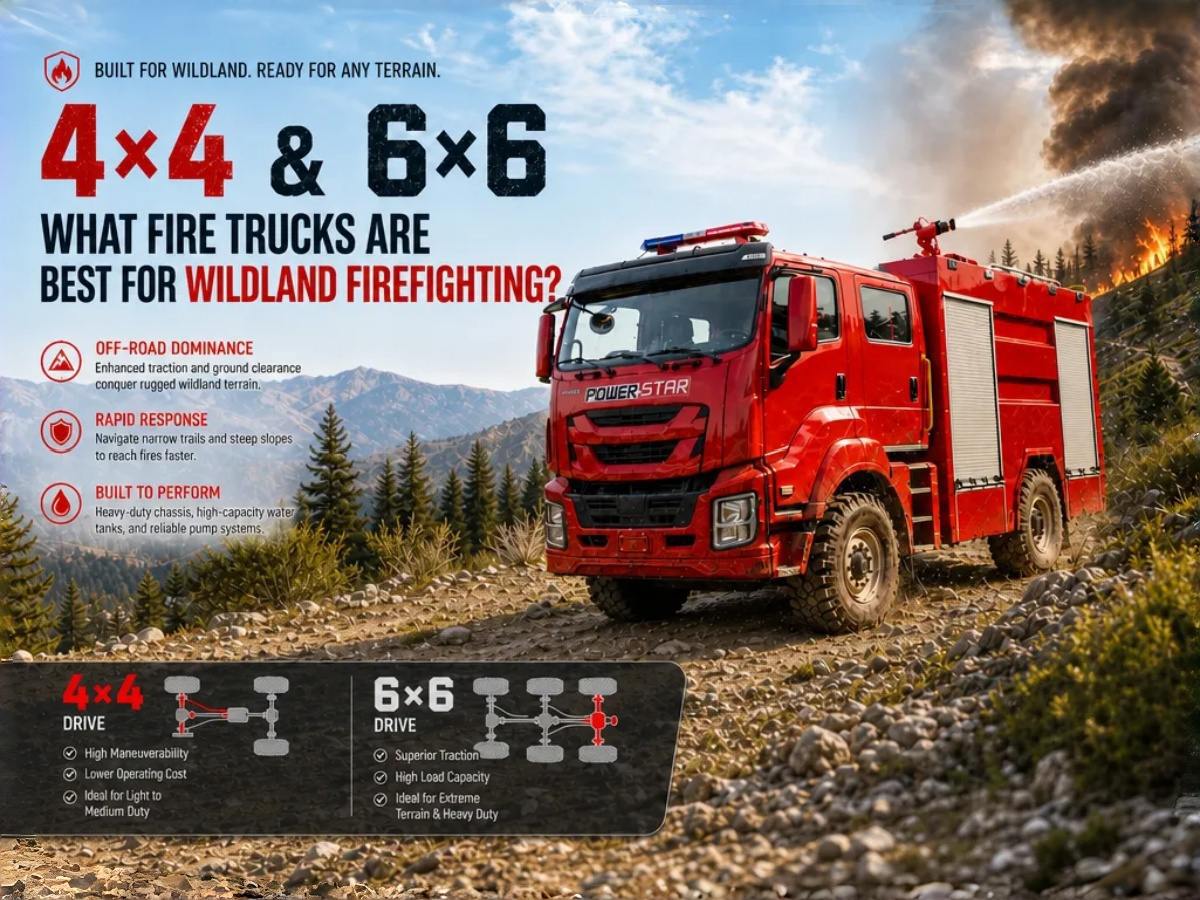
野外消防面临的挑战与建筑消防有着根本性的不同。在偏远森林、草原和山地地形中,消防车必须穿越狭窄道路、攀爬陡坡,并且在远离消防栓或水源的地方作业。选择合适的消防车是一项战略决策,直接影响响应时间、人员安全和灭火效果。 本文将全面介绍最适合野外消防的消防车类型、其核心特点以及选择方法,帮助您根据具体作业需求做出正确决策。 快速解答 野外火灾具有火灾范围大、地形复杂、水源有限以及道路条件差等特点,因此没有一种消防车能够应对所有森林火灾场景。 一般来说,野外消防主要使用以下类型的消防车: • 轻型野外消防车:用于森林道路通行和快速响应• 4×4越野型野外消防车:用于山地和丘陵地形• 6×6野外消防车:用于大型森林火灾和长时间作业• 水罐车:用于持续供水和支援• 泡沫消防车:用于石油设施、森林设备或特殊火灾• 救援车辆:用于通信、照明、破拆和后勤支援 一、为什么野外火灾需要专用消防车? 野外火灾与建筑火灾在多个关键方面存在根本差异: 野外火灾的主要特点:• 火灾范围大,可覆盖数公顷土地• 风向变化迅速• 地形复杂且崎岖• 消防栓或水源有限,甚至无法获取• 狭窄、未铺设路面的森林道路• 通信条件困难 标准城市消防车通常不适用于野外消防,原因如下: • 缺少用于未铺装山路和陡坡的4×4或全轮驱动;• 车身尺寸较大且离地间隙较低,容易在狭窄森林道路和松软地形中陷住;• 城市消防泵注重中等压力下的大流量,而野外作业需要在水量有限的情况下,通过长距离铺设水带实现高压力供水——这是完全不同的作业方式。 二、常见野外消防车类型 消防车型 主要特点 适用场景 轻型野外消防车 机动性高,车身紧凑 森林巡逻,初期灭火 4x4野外消防车 强大的越野能力 山地和丘陵地形 6x6野外消防车 大容量储水,持久续航 大规模森林火灾 运水车 持续供水 物流支援,水源接力 泡沫消防车 特殊灭火 森林油库、设备区域 救援车辆 设备运输 综合救援行动 III. 野外消防车需要具备哪些关键性能特点? 1. 越野能力 野外消防车需要具备强大的越野性能,以便在复杂地形中有效作业: 驱动配置:• 4×4驱动是大多数野外作业的最低标准,可在松软土壤、砾石和陡坡上提供牵引力• 6×6驱动为在极端条件下作业的大型车辆提供更强的牵引力和承载能力• 配备多种地形模式(泥地、雪地、岩石、沙地)的全时四轮驱动,可在不同环境下实现优化性能 差速锁:前、中、后差速锁可确保当其他车轮失去抓地力时,将动力分配给仍有牵引力的车轮,这对于穿越崎岖地形和防止车辆被困至关重要。 离地间隙:最低300-400毫米离地间隙可使车辆越过岩石、倒下的树枝和不平整地面,同时避免底盘损坏。 接近角和离去角:• 接近角≥30°,可防止前保险杠撞击坡面或障碍物• 离去角≥25°,可防止车辆下陡坡时尾部拖地 2. 水箱容量 在野外消防中,水箱容量必须在机动性和车辆重量之间取得平衡: 为什么更大并不总是更好:• 更大的水箱会增加显著重量,提高车辆陷入松软森林土壤的风险• 重型车辆具有更高的重心,增加了在侧坡上翻车的风险• 更重的车辆会对森林道路和小径造成更大损害• 重量增加会提高燃油消耗,降低作业范围 按任务类型推荐的水箱容量: 任务类型 推荐水箱容量 理由 快速攻击 / 巡逻 1,500-2,000升 轻量化设计,兼顾速度和机动性 初期攻击(标准) 2,000-3,000升 平衡的容量与机动性 延长作业 3,000-5,000升 更长续航能力与适度机动性 供水 / 接力供水 5,000-8,000升 最大容量,仅限道路行驶或有限越野 3. 消防泵系统 泵是任何野外消防车的核心。野外消防泵与建筑消防泵存在根本区别: 参数 城市消防泵 野外消防泵 流量 高(1,000-2,000 GPM) 中等(30-150 GPM) 压力 中等(150-200 psi) 高(250-400 psi) 重点 用于消火栓供水的流量 用于长距离铺设水带的压力 吸水 偶尔 经常从自然水源吸水 为什么野外消防泵优先采用高压力:• 长距离铺设水带(最长可达1,000多英尺)需要高压力来克服摩擦损失• 高压力使水能够到达陡坡和高地形上的火灾区域• 高效用水,在有限车载供水条件下最大化灭火效果 高压雾化系统:• 将水分解成超细水滴(≤1mm),实现最大冷却效率• 与标准水流相比,可减少高达70%的用水量• 实现快速降温和压制烟雾• 在大型供水到达前,可有效用于初期攻击 4. 绞盘 绞盘是野外消防车在偏远地形作业时的必备设备: • 自救: 当车辆陷入泥泞、沙地或松软森林土壤时,将车辆拉出• 障碍物清除:拖走阻挡道路的倒木、岩石或碎屑•协助其他车辆:救援或重新定位其他被困设备•救援行动:进入无法通过其他方式到达的区域 推荐配置:配备前置绞盘,最低拉力能力为8,000-10,000磅,使用合成绳以提高安全性并减轻重量。 5. 自我保护喷淋系统 野外消防车在活动火线内或附近作业时,必须保护自身: 车辆底盘喷淋:车辆下方的喷水喷嘴可冷却底盘、轮胎和底部部件,防止在燃烧地面上行驶时发生热损伤和轮胎起火。 驾驶室喷淋系统:喷水覆盖挡风玻璃和驾驶室外部,以降低辐射热并保持视野,使消防员在极端高温环境下仍可留在车内。 轮胎喷淋系统:将水直接喷向轮胎,防止在火焰附近或高温表面作业时橡胶软化、熔化或起火。 IV. 购买野外消防车时应关注哪些关键参数? 在选定野外消防车辆配置时,应优先考虑以下参数: •底盘品牌和型号:具有良好越野可靠性和完善服务支持的知名品牌•发动机功率:在满载水量情况下具备爬升陡坡所需的足够马力(通常为250-400+马力)•驱动配置:最低要求为4×4,大型车辆或极端地形使用6×6•水箱容量:根据任务需求和地形条件匹配(见第三节第2部分)•泵流量和压力:6型车辆最低为30 GPM @ 250 psi,3型车辆为150 GPM @ 250 psi•最大可爬坡度:山地作业至少达到30°(60%坡度)•最小转弯半径:足够紧凑,适合森林道路的连续急转弯路段(通常≤10米)•自我保护系统:用于火场前沿作业的底盘和驾驶室喷嘴•绞盘配置:前置绞盘,具有足够的牵引能力•设备舱布局:模块化设计,便于快速部署时进行操作•维护便利性:便于接近维护点,以进行现场维修和日常保养 五、常见问题解答(FAQ) 1. 野外消防车是否始终需要4×4驱动? 大多数野外消防作业建议采用4×4或6×6驱动,以提升复杂地形中的越野能力。 2. 野外消防车需要多大的水箱? 常见配置范围为2,000升至8,000升。选择应根据道路状况和任务需求确定。 3. 为什么野外消防车通常比城市消防车小? 较小的车辆更容易通过森林道路、桥梁和狭窄的山间小路,同时降低陷入困境的风险。 4. 泡沫可以用于野外消防吗? 可以,但主要用于森林油料设施、机械设备或特殊火灾场景。标准植被火灾仍主要使用水进行扑救。 5. 为什么野外消防车需要绞盘? 绞盘可实现车辆自救、清除障碍物以及帮助其他被困车辆。它们是偏远地区作业的必备设备。 6. 购买野外消防车时最重要的规格是什么? 越野性能、可靠性、续航能力、泵性能和维护便利性通常比单纯追求更大的水箱容量更重要。 六、结论 野...
细节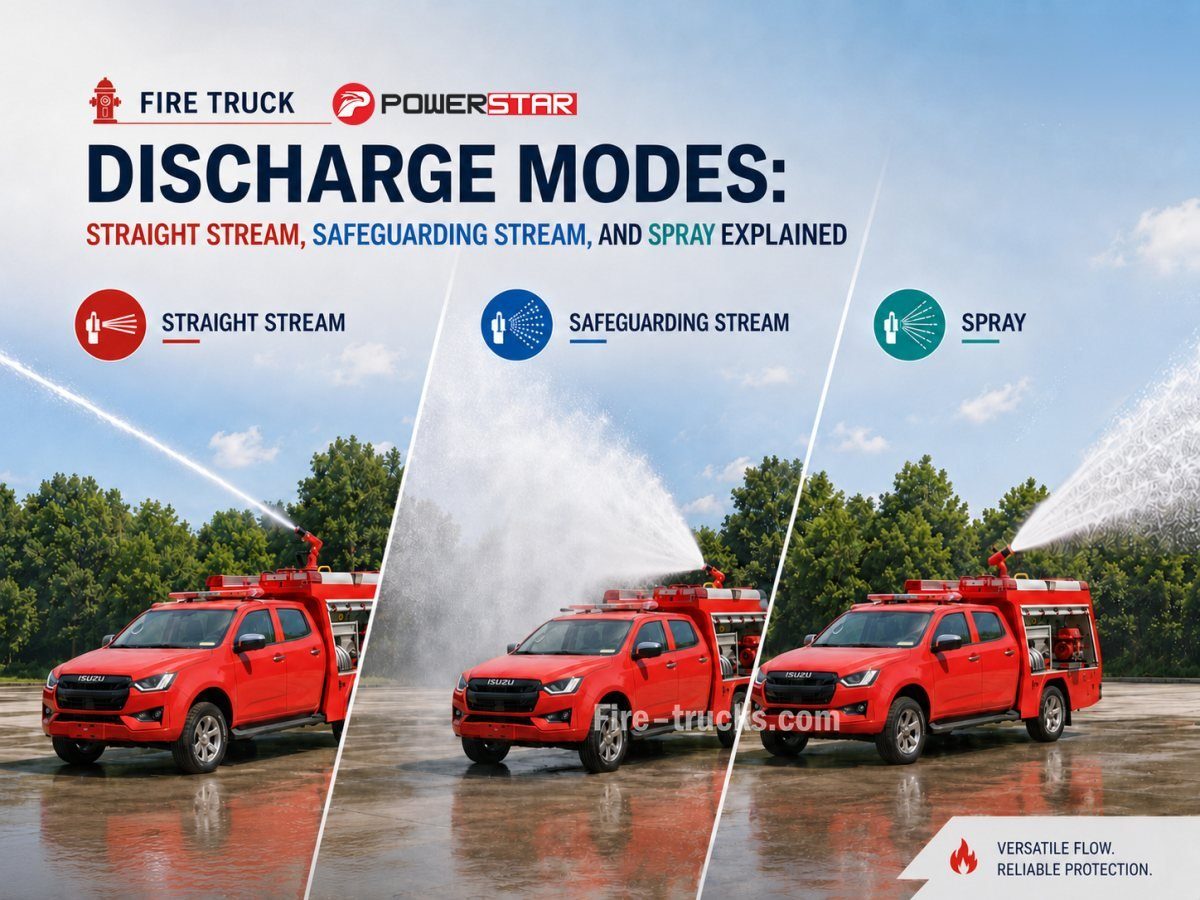
在消防作战中,出水模式的选择直接决定灭火效率、作业安全性以及火势控制效果。大多数人并不了解,消防车水枪可以在三种核心出水模式之间切换:直流水、喷雾水和防护水流。不同模式在水流形态、射程、冲击力和覆盖面积方面存在显著差异,每种模式分别对应完全不同的适用火灾场景。 本文基于专业消防作业标准,全面分析三种出水模式的原理、关键特点和适用场景,帮助我们的客户系统掌握消防车出水技术。 一、为什么消防车需要不同的出水模式? 直流水、喷雾水和防护水流分别对应三种不同的灭火机制:冲击灭火、汽化窒息和热辐射防护。消防员必须根据现场情况灵活切换。那么,为什么不能一直使用一种水流形式? 1. 火灾类型的多样性要求使用不同形式的灭火介质 不同类型的火灾具有不同的燃烧特性,这决定了适用的灭火方式: • A类固体物质火灾需要直流水冲击,破坏燃烧物并渗透进行内部冷却; • B类液体火灾不能使用直流水冲击(会造成液体飞溅并扩大火势),而应使用防护水流或喷雾水进行覆盖和稀释; • E类带电电气火灾只能使用喷雾水,因为细小水滴不会形成连续导电通路; • 封闭空间火灾需要使用喷雾水充满整个空间,通过汽化吸热和窒息作用实现灭火。 没有任何一种模式能够适应所有类型的火灾。 2. 同一火灾的不同阶段需要不同的战术方式 即使面对同一场火灾,不同阶段也需要采用不同的出水模式: • 火势猛烈的初期阶段,需要使用直流水对火点进行远距离冲击,实现快速压制; • 推进过程中,需要使用防护水流形成水幕屏障,阻挡热辐射并保护人员; • 进入房间前,需要使用喷雾水冷却并稀释烟雾和气体,为内部进攻创造条件。 单一模式无法覆盖整个灭火过程中的全部作战需求。 3. 射程、覆盖面积和冷却效率无法同时兼顾 三种模式在三个关键维度上各有优势和不足: • 直流水射程最长(可达120米以上),但覆盖面积较小,仅呈点状覆盖; • 喷雾水能够充满空间,汽化吸热效率最高,但射程最短; • 防护水流覆盖面积大,呈扇形展开,但射程较短。 由于火灾类型不同、发展阶段不同以及战术目标不同,没有任何一种水流形式能够适用于所有火灾场景。三种模式的组合使用和快速切换,是消防车适应不断变化火场环境的基础作战能力。 二、直流水模式:远距离攻击,直接穿透深层火源 直流水 该水流的喷射边缘角度为0°,且没有实心水柱段。水流以高度集中的柱状形式喷出,具有远射程和强冲击力,是三种模式中射程最远的一种。标准消防水枪可实现21-39米的直流水射程,而高压消防炮射程可超过120米。 1. 工作原理 消防车输出的高压水流通过专用直流水枪后,被引导并集中。雾化效果被消除,水流完全聚焦,形成密集、调节良好的高压柱状水流,持续稳定地喷射,确保水流动能不会分散,同时保持最大射程。 2. 主要特点 直流水的整体特点十分鲜明,具有四项核心属性:高度集中的水柱、最长出水距离、最大冲击力以及极强的火焰穿透能力。它是三种出水模式中动力性能最优的一种形式。 3. 优点与缺点 优点:适用于远距离灭火作业;能够穿透表面火焰和烟雾,到达深层火源;可配合消防车炮进行大流量、远距离持续喷射,非常适合高层建筑和开放区域的大规模火灾。 缺点:水流集中且单一,导致覆盖面积较小,整体冷却范围有限;定点高压喷射容易造成建筑内部和设备积水损害,并产生较明显的二次损失。 4. 推荐应用场景 直流水适用于高强度、远距离、深层火源的明火火灾。核心适用场景包括:各种民用和商业建筑明火火灾、仓储火灾、高层建筑外部和内部深层火灾、森林及野外远距离明火灭火,以及使用消防炮进行的大型工业厂房和设备灭火作业。 III. 喷射流模式:针对特殊火灾场景的超细雾化、冷却和防爆保护 喷射流 平均雾滴尺寸不大于1毫米,射流边缘角大于0°,且无实心段。水流被分解成极细的雾状颗粒,具有极高的汽化吸热效率,适用于室内火灾、带电电气火灾以及有毒气体稀释。 1. 工作原理 依靠消防车高压雾化喷嘴的特殊结构,传统水流被高速切割并分散。水流从喷嘴喷出时,受到离心力作用被撕裂成细小水滴(≤1毫米),形成扩散状雾流。水雾在汽化过程中吸收大量热量,快速降低火场温度,同时水蒸气稀释燃烧区域内的氧气浓度。 2. 主要特点 喷射流具有最细的水滴和最大的空气接触表面积,其冷却吸热效率远超直流水和防护水,能够节约用水并提高资源利用效率,提供卓越的灭火精准性。 3. 优点和缺点 优点:火场冷却速度极快,可迅速降低烟气温度并稀释有毒和可燃气体;操作安全性高,显著提高人员救援和搜救作业的安全系数,同时节约用水并减少二次水损害。 缺点:三种模式中喷射距离最短,动量相对较弱;雾流稳定性较差,容易受风影响;不适用于大面积室外火灾,无法压制高强度明火。 4. 推荐应用场景 喷射流专门适用于特殊高风险、封闭和精准控制场景。核心适用场景包括:各种室内封闭空间火灾;带电电气设备火灾(严格遵守安全操作规程);船舶封闭舱室内的消防作业;以及地铁、隧道等封闭狭窄空间内的灭火。 IV. 防护流模式:均衡覆盖,结合灭火与保护 防护流 平均雾滴尺寸大于1毫米,是一种用于降低热辐射的扇形水流。水流以扇形方式扩散,覆盖面积大但射程较短,适用于近距离大范围覆盖和热辐射防护。 1. 工作原理 水流通过锥形导流装置后呈扇形扩散,雾滴尺寸大于1毫米,形成伞状水幕。射程较短但覆盖面积较大,主要用于“扩散覆盖”和“热辐射隔离”。 2. 主要特点 防护流的核心优势在于覆盖面积广,具有出色且均衡的整体火场冷却效果。它能够快速形成连续水幕屏障,既可用于灭火和控制火势,也可用于火场热防护,具有较强的综合适应性。 3. 优点和缺点 优点:可快速压制明火,控制水平方向火势蔓延,并对高温建筑结构和设备进行大面积冷却;可形成隔离水幕,有效阻挡火场热辐射并隔离高温烟气,为一线消防人员提供全面保护。 缺点:射程明显短于直流水,不适用于远距离灭火;水流扩散后动量减弱,对火焰和碎屑的穿透能力相对较弱,不适用于深入火源的攻击。 4. 推荐应用场景 防护流重点用于防护和火势控制。核心适用场景包括:建筑外墙及周边火场区域冷却,工业储罐表面冷却和阻燃处理,化工厂设备隔热保护,火场水幕隔离与阻隔,以及各种中小型初期火灾的火势控制作业。 V. 三种出水模式的核心区别与快速选择指南 出水模式 流动特性 核心优势 直流水 柱状且密集,射程远,冲击力强 穿透力强,适合远距离灭火,攻击能力强 喷射流 超细雾滴,全面覆盖,快速吸热,隔热性能好 冷却和窒息灭火,防爆和排烟,安全系数高 防护流 雾滴状分散,覆盖范围广,冲击与防护能力均衡 强大的通用性,兼具灭火与防护、排烟与降温功能 六、消防炮如何切换喷射模式? 安装在车顶或固定支架上的消防炮相比手持式喷枪提供了更多样化的切换方式。根据控制方式可分为以下四种类型: 1. 手动调节喷嘴 消防员直接站在消防炮位置,通过转动手轮或拉动操纵杆调节喷嘴开度或导流锥位置,从而切换模式。 优点:纯机械结构,不依赖电力,在极端环境下可靠性高,成本低。缺点:人员必须靠近消防炮位置,存在高温热辐射风险;调节速度较慢。 适用:乡镇消防车、企业消防队车辆、预算有限的采购项目。 2. 电控消防炮 消防炮内置电动执行机构(由电机驱动)。消防员通过驾驶室内的控...
细节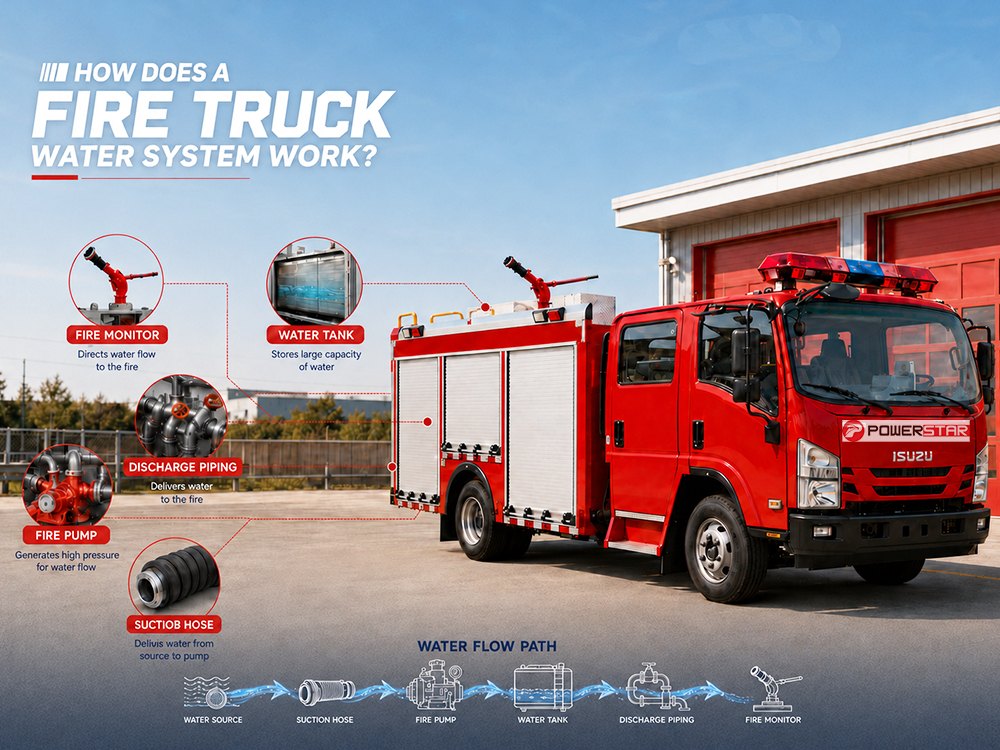
消防车水路管道系统是每次灭火行动的核心。它精确地将水从水箱或外部水源引导,经过水泵、阀门和管路,向火灾现场输送高压水流或泡沫——无论是人口密集城市中心的高层建筑火灾,还是工业区内的石化储罐火灾。消防车水路管道系统由多个协同工作的部件组成:消防泵、水箱、吸水软管、出水管路、阀门、分流器、集流器、滤网、消防炮、水带接头等。 完整的水流路径为:水箱 → 吸水软管 → 滤网 → 消防泵 → 压力调节系统 → 出水集管 → 阀门 → 分流器 → 消防炮 / 水带接头 → 喷嘴 本文介绍水路管道系统的各个部件,以及它们如何协同工作,以合适的压力和流量输送水。 一、水路管道系统的核心部件 水箱 储存车载供水。 ● 容量:通常为2,000–12,000升。 ● 输送:通过进水管路向水泵供水。 ● 特点:配备防荡隔板以提高车辆稳定性,滤网用于过滤杂物,并配备引水系统以便从天然水源取水。 消防泵 由卡车发动机通过取力器(PTO)驱动的离心泵;可采用单级/多级结构,材质可为铸铁或青铜。 ●压力等级:提供0.8 MPa、1.0 MPa、1.2 MPa和1.4 MPa等标准额定压力,满足典型灭火需求。 ●流量:范围为1,200至6,000 L/min,其性能曲线针对高压和大流量作业进行了优化。 阀门和管路 由管道和阀门组成的网络,用于控制水流方向和流量。 ●进水阀:将水泵连接至外部水源(消防栓或取水点) ● 水箱至水泵阀:使水泵能够直接从车载水箱抽水 ● 出水阀:控制流向水带和喷嘴的水流 二、消防车水路管道系统的工作原理 步骤1:进水和引水 水从车载水箱、消防栓或天然水源(湖泊、河流、池塘)进入系统。当从天然水源取水时,引水系统(真空泵)会排出吸水软管中的空气,形成真空,使大气压力将水推入水泵。滤网过滤杂物以保护水泵,止回阀则防止回流。 步骤 2:泵增压 离心泵通过取力器(PTO)由卡车发动机驱动。水充满泵体后,叶轮以高速(1,500–2,500 RPM)旋转。离心力将水甩向外侧,提高水流速度。泵壳将该速度转换为压力(通常为 0.8–1.2 MPa)。电子压力调节器会自动维持设定压力,同时泄压阀防止压力过高。 步骤 3:排水与分配 加压后的水从泵流经排水歧管,歧管将水分配至多个出口。阀门控制每个出口的水流。分水器将水流分成多条水带,使多名消防员能够同时进行灭火。集水器在需要额外流量时,将多条供水管路中的水汇集起来。水通过消防炮(高流量远程灭火)、水带(直接灭火)和高压卷盘(局部火灾)输送。 III. 完整消防车供水管路系统 1. 进水系统(水源供应与过滤) 部件 材料 / 工艺 功能 吸水管 åˆ
细节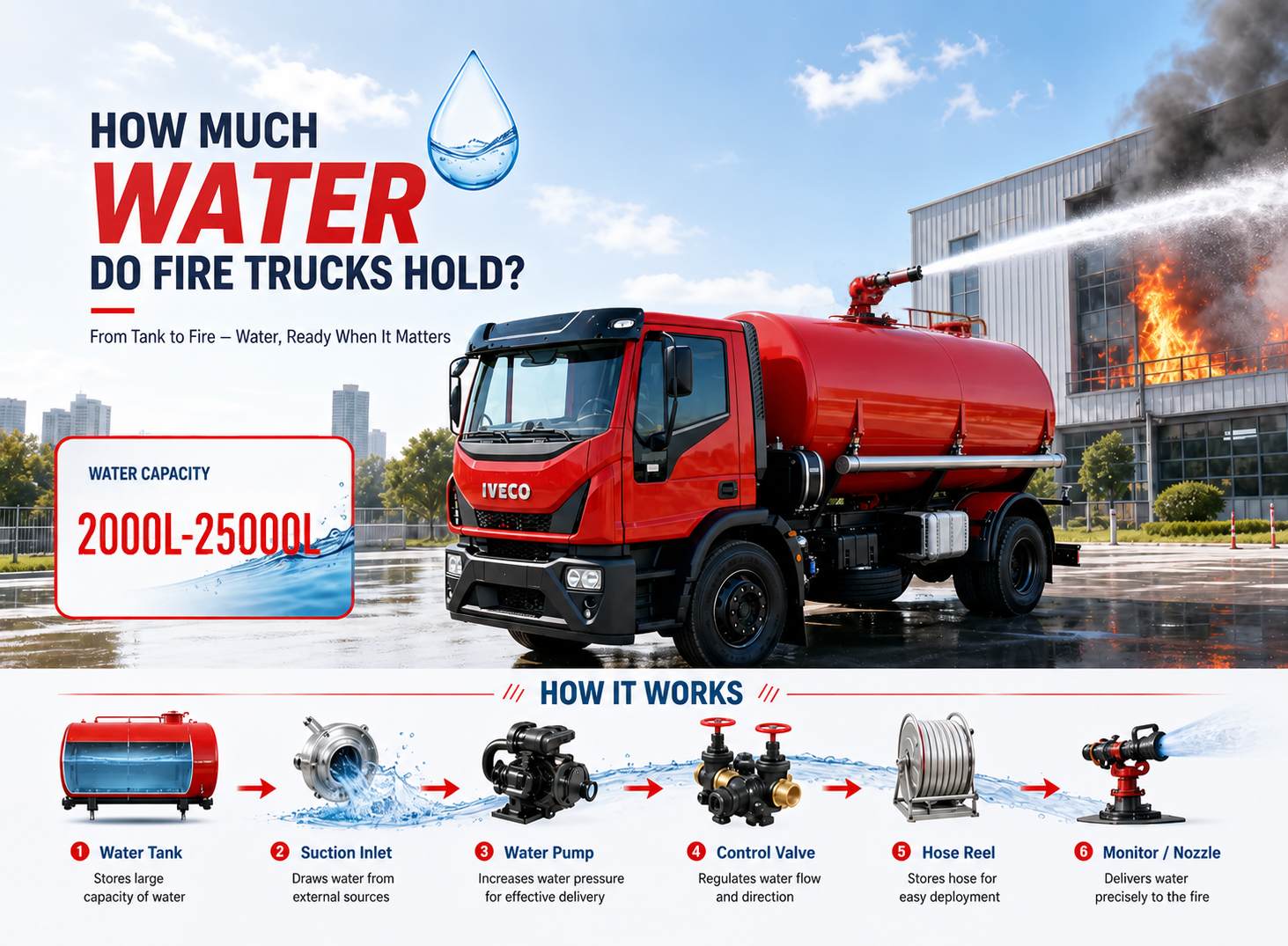
消防车可以装载多少水?这是我们的客户在选择消防车时面临的首要问题之一。没有一个固定的单一数值——它取决于车辆类型、底盘承载能力、设计用途和地区法规,范围从2,000升的轻型车辆到25,000升的工业消防车不等。但更大的水箱并不总意味着更好的性能;消防车辆 水箱容量必须与泵流量、消防炮排放流量以及底盘承载能力进行合理匹配,才能实现有效的灭火效果。 本文从消防车水箱容量的基础知识入手,分析不同车辆类型的典型储水范围,探讨影响水箱设计的关键因素,并提供实用的采购指导。 关键要点: 消防车水箱容量通常范围为2,000至25,000升 不同类型的消防车具有不同的水箱容量 更大的水箱并不意味着更强的灭火能力 水箱容量必须与泵流量、消防炮流量以及底盘承载能力相匹配 工业消防通常需要大型水箱,而市政消防更重视机动性 » 一、三种基本消防车水箱类型 泵浦消防车:这些是最常见的市政消防车。它们主要依靠消防栓供水,并携带约1,900–3,800升车载水,用于初期灭火。此类车辆的核心是水泵,而不是水箱——它们的设计目的是在连接消防栓后输送加压水流。 水罐消防车(供水车):这些车辆专门用于运输大量水,水箱容量通常超过11,400升。在没有消防栓的农村和偏远地区,它们发挥着关键作用,通过在水源和火灾现场之间往返运输水,为泵浦消防车提供用水。 泵浦水罐消防车:这些车辆将泵送和运水功能结合于一体。它们既可以进行灭火供水,也可以为其他车辆提供水源。水箱容量通常在5,700至11,400升之间,是消防部门的多功能解决方案。 » 二、不同类型消防车可以携带多少水? 消防车型 典型水箱容量 主要应用 轻型消防车 2,000–3,000升 城市快速响应、初期灭火 市政泵浦消防车 3,000–6,000升 市政消防、建筑火灾 中型泵浦消防车 6,000–10,000升 城市与工业综合任务 重型泵浦消防车 10,000–15,000升 长时间作业、远距离响应 工业消防车 15,000–25,000升 石油、化工、矿业消防 » 三、消防车水系统如何工作? 消防车不仅仅是一个移动水箱——它是一套完整的供水系统。水箱中储存的水必须经过多个关键部件,才能到达火灾现场。完整的水流路径如下: 水箱 → 进水管路 → 消防泵 → 压力控制系统 → 出水汇流管 → 消防炮/喷嘴/水带 水箱 水箱是核心储水容器。其设计直接影响可用水量和使用寿命。 防荡板:水箱内部用于防止行驶和急转弯时水体剧烈晃动的隔板,可保持车辆稳定性。 耐腐蚀材料:水箱通常采用304不锈钢或涂层碳钢制成,以抵抗长期水腐蚀。 人孔:位于水箱顶部的检修入口,用于内部检查、清洁和维护。 液位指示器:实时显示剩余水量,帮助操作人员规划灭火策略。 进水管路 进水管路将水从水箱输送至消防泵。其通常采用大直径设计以降低流动阻力,并配备止回阀以防止回流,同时安装过滤器以防止杂物进入水泵。 消防泵 消防泵是供水系统的动力核心,负责: 建立水压以克服管道阻力和垂直扬程 提高流量以满足灭火需求 为长时间作业提供持续供水 出水系统 加压后的水通过出水集管输送至各种供水设备,包括消防炮(用于大流量远程灭火)、手持喷嘴(用于精准灭火)、高压水带卷盘(用于局部火灾或快速响应)以及多个出水口(用于同时连接多条水带)。 » IV. 为什么消防车无法排出水箱容量的100%? 许多人认为,10,000升水箱可以排出10,000升水。实际上,可用水量通常低于水箱的标称容量。主要原因如下: 1. 吸水入口高度限制 消防泵的吸水入口通常设置在水箱底部上方一定高度处,而不是与水箱底面齐平。这样设计是为了防止吸入沉积在底部的泥沙和杂质。但这也意味着水箱最底部约5%–10%的水无法被水泵吸取和利用。 2. 防止空气进入消防泵 吸水入口必须始终保持完全浸没状态,以防止空气被吸入泵体。一旦空气进入,可能导致水泵空转,引发气蚀(叶轮在空气气泡和水的混合物中旋转,气泡破裂产生冲击波并损坏叶轮),并导致压力突然下降。严重情况下,这可能损坏甚至毁坏消防泵。 3. 水箱内部防荡板的影响 防荡板将水箱分隔成多个舱室。虽然它们能有效抑制车辆行驶时水体晃动,但这些舱室底部的过水孔相对较小。在低水位情况下,水流速度受到限制,使部分水无法及时到达吸水管区域。 标称容量 可用容量 损失比例 5,000 L 约4,500–4,700 L 6%–10% 10,000 L 约9,000–9,400 L 6%–10% 15,000 L 约13,500–14,100 L 6%–10% » V. 水箱容量与消防泵流量的匹配 匹配原则:如果泵的流量过高,水箱将在几分钟内耗尽。如果流量过低,则无法充分利用大容量水箱。一般建议,在额定流量下的连续放水时间不应少于5–10分钟。 水箱容量 推荐泵流量 推荐应用场景 2,000 L 30 L/s 小型消防车、社区消防 3,000–5,000 L 40 L/s 市政消防、初期灭火 6,000–8,000 L 60 L/s 市政消防、建筑火灾 10,000–15,000 L 80 L/s 工业消防、长时间作业 15,000 L及以上 100 L/s及以上 石化行业、机场消防 » VI. 影响消防车水箱容量的五个关键因素 1. 底盘承载能力 水箱容量主要受车辆总重量(GVW)的限制。常见消防车底盘包括4×2、6×4和8×4驱动配置。轴距越长、车轴数量越多,总承载能力越高。例如,6×4底盘通常可以安装比4×2底盘更大的水箱。此外,水箱的安装位置必须考虑前后轴载荷分布,以确保车辆在满载和空载情况下均保持稳定性和机动性。 2. 消防泵流量 消防泵流量与水箱容量之间合理匹配至关重要。对于流量为30 L/s的泵,一个10,000升水箱大约可在5.5分钟内排空;而60 L/s的泵将在不到3分钟内将其排空。泵流量越高,水箱消耗越快。因此,在选择规格时,高流量泵应搭配更大容量水箱,以确保足够的连续作业时间。相反,低流量泵配备过大的水箱会造成车辆有效载荷和成本的浪费。 3. 消防炮流量 消防炮是主要的用水设备。大型消防炮的流量可达到48–100 L/s甚至更高。高流量消防炮可在几分钟内耗尽整个水箱。因此,配备高流量消防炮的消防车必须安装相应的大容量水箱,或能够快速连接外部水源。 4. 消防任务类型 不同类型的火灾对水箱容量有不同要求。对于城市建筑火灾,消防员通常可在3–5分钟内连接消防栓,因此车载水箱主要用于初期灭火,容量需求相对适中。对于工业火灾,火场通常距离消防栓较远,灭火作业持续时间更长,需要配备超过10,000升的大容量水箱。对于森林火灾,消防车需要长距离行驶并持续供水,因此容量和续航能力都至关重要。 5. 底盘布局 水箱、泡沫罐和设备舱在底盘上的布置方式会直接影响可安装的最大水箱容量。发动机位置决定可用空间;泡沫罐的配置会占用部分空间;设备舱的数量和尺寸也会直接影响最终水箱容量。 » VII. 常见问题(FAQ) 1. 消防车通常可以携带多少水? 大多数市政消防车携带3,000–10,000升水。大型工业消防车可达到15,000–25,000升,而小型消防车通常携带500–1,500升,具体取决于车辆类型和用途。 2...
细节
请继续阅读,保持关注,订阅,并欢迎您告诉我们您的想法。


 中文
 English
 français
 Deutsch
 русский
 italiano
 español
 português
 Nederlands
 العربية
 日本語
 한국의
 Türkçe
 Melayu
 ไทย
 Tiếng Việt
 Indonesia
 қазақ
 Filipino
 မြန်မာ
 српски


 支持IPv6网络